
Pallavi Lakshmi Lakra | Updated: May 15, 2019 | Category: Cheque Bounce
Comprehensive Guide for Cheque Bounce in India
Industrial Revolution brought changes in the market field. Therefore, there has been an increase in transactions on a daily basis. To ease the business transactions usage of Cheques has amplified. With this, the issues of cheque bounce is on the rise.
In this article, we will see the ingredients of Cheque, cheque bounce and the legal recourse for dishonour of cheque in India
Basics of Cheque Bounce
Before going into the details of about dishonour of cheque let us understand about what is Cheque.
A cheque is a negotiable instrument under the Negotiable Instrument Act. In other words, it is a bill of exchange which is payable on demand. The one who issues the Cheque is known as drawer and the person in whose favour the drawer issues the Cheque is known as the drawee. One has to deposit the Cheque in the payee’s bank account.
Cheque plays an essential role in transactions be it small or large. In addition, it also helps the people at large by easing business. The issue of cheque bounce occurs If there is non-payment of the amount because of lack of balance in the drawer’s account. Therefore, if there is a dishonour, one sends a notice to the issuer of the Cheque that legal recourse will be taken for payments.
Characteristics of a Cheque
- It should be in writing
- It should be an unconditional order
- Additionally, the drawer has to specify the banker details
- Payment is made to a specific individual
- Payable on demand from a specified party
- Cheque should be of certain amount of money
- Lastly, it should be signed by the drawee
Reasons for Cheque Bounce in India
Insufficent funds
Mismatch of signature
Expried Cheque
Date mentioned on cheque is unreadable
Diffrent in amount written in words and numericals
Damaged Cheque
Account number dose not match
Overwriting on the cheque
Suspicion of fraud by the bank
Indian Laws for Cheque Bounce
In India, as per Section 138 in The Negotiable Instrument Act, 1881 cheque bounce is a punishable offence. This Act helps the complainant to get compensation for the inconvenience due to dishonour of cheque, and it also adds a punitive element for better implementation of the legal framework.
- As a matter of fact, the law categorizes dishonour of Cheque as a criminal offence under Section 138. Additionally, it is a punishable offence with imprisonment up to 2 years or with fine or both.
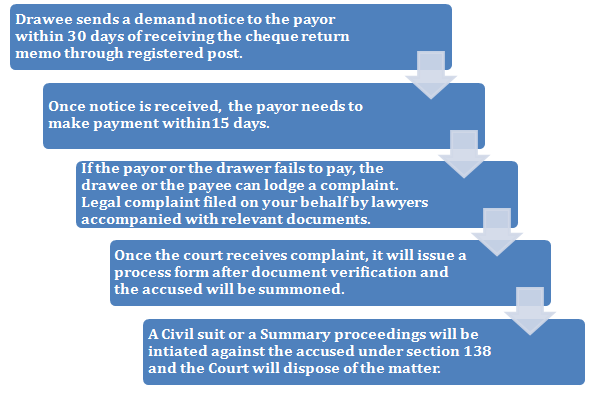
- One sends a legal notice along with the return memo to the defaulter within 30 days of cheque bounce. The drawee has to send a cheque bounce notice with the object of giving the drawer an opportunity to make the payments immediately and avoid Court.
- Furthermore, the section states that if the payment is made within the span of 15 days of receiving the notice, then there is no need to file a case. But, if the drawer fails to reply after 15 days of notice, then the drawee can file a case against the drawer.

The objective behind Section 138
Through Section 138, the Court encourages the parties for out of court settlement without hampering the rights of the parties. In addition to this the Court also has the power to discharge the case if it believes the cheque amount is already paid, and there is no point in going forward with the case.
Interim Relief under New Amendment
Recently, the government has passed the Negotiable Instruments (Amendment) Bill for a quick recourse in matters of cheque bounce. Moreover, the Bill states that the Court can give an order against the defaulter for interim compensation to the complainant.
Time Frame for Cheque Bounce Case

What are the requirements for a cheque bounce notice?
The requirement for Cheque Bounce notice–
- The Cheque should be towards a specific liability.
- Moreover, it should be done within the validity period.
- Due to insufficient funds, the bank must have returned the Cheque.
- Within 30 days of the receipt of information from the bank regarding the insufficiency of funds, demand is raised by the payee by giving a written notice for the payment.
- Additionally, within 15 days of the receipt of the written notice of cheque bounce, drawer fails to make payment of the said amount.
- Lastly, within one month from the date cause-of-action, legal action can be initiated.
The Procedure for Sending Cheque Bounce Notice
Ingredients of Cheque Bounce Notice
The Notice should contain the following ingredients-
- Firstly, it should have the details of the drawer
- Secondly, it should state that the Cheque is for the discharge of debt/liability in whole/part and not given as a gift or loan.
- The Cheque was present within the validity period.
- It should mention the return date of Cheque accompanied with reasons for such return.
- Additionally, one has to send a demand notice within 30 days of intimation of dishonour of cheque, giving 15 days time period for making payments.
- If accused does not make the payments accordingly, the drawer can approach the Court and file a criminal complaint under section 138.
- Lastly, the notice has to be sent through registered post.
Can a complainant file case on the second cheque bounce notice after the re-presentation of Cheque?
Yes, we can file a complaint based on the legal notice. In this reference the Supreme Court in 2013 judgement held-
There is nothing in the provisions of Section 138 of the Negotiable Instrument Act that forbids the holder of the Cheque Cheque to make successive presentation of the cheque and institute the criminal complaint based on the second or successive dishonour of the cheque on its presentation.”
Conclusion
Cheque Bounce is a very common problem nowadays. Therefore, in India, we have laws to curtail the dishonour of cheques and help the individual/companies to face the issue of cheque bounce. The Law in India has a compensatory as well as punitive approach. For instance, we provide a time limit to the drawer to make the full payments. Further, if payments are not made, then the parties can approach the Court for non-payment.
For more information and assistance in drafting Cheque Bounce Notice contact our team of expert lawyers at LawyerINC.