
Pallavi Lakshmi Lakra | Updated: Jun 25, 2019 | Category: Legal
How do I get Marriage Registration in India?
Marriage in India is a sacred sacrament which binds two people together. It is an agreement whereby both the parties agree to spend the rest of their lives together. Married or getting married soon, you should have knowledge about registration of marriage in India. People generally tend to ignore the marriage registration procedure. This is important because marriage will only be considered legal after registration.
If you want to register your marriage and are unaware about the procedural details of marriage registration, this article will guide you through marriage registration.
What is Marriage Registration?
Registration of marriage gives legal validity to marriage. In India, the marriage registration procedure is different for different states.
If you are already married, then you can register your marriage under the Hindu Marriage Act, 1955 or Special Marriage Act, 1954. Moreover, the Hindu Marriage Act will only be applicable if both spouses are Hindus. It is applicable to Buddhist, Jain or Sikh or anyone who has converted to these religions as well. Additionally, it also states that if either of the spouses is not Hindu, Buddhists, Jain or Buddhist, then the Special Marriage Act, 1954 comes into picture.
Marriage Registration Certificate
A marriage registration certificate is an official declaration which states that two people are legally married. If there is any dispute between the parties, then this certificate will act as legal proof for their marriage. In 2006, the Supreme Court made it mandatory to register the marriage for safeguarding women’s rights. Hence, obtaining a marriage certificate after marriage can have various benefits.

Marriage Registration Laws in India
The two main laws dealing with registration-
The Hindu Marriage Act, 1955
There are certain conditions which are to be fulfilled under The Hindu Marriage Act, 1955–
- The people wanting to get married should be unmarried and not having a living spouse.
- The groom should be 21 years old, and the bride should be 18 years old.
- Both the parties have to mentally fit, and consent should be freely given.
- The parties to the marriage should not be sapindas to each other except if they are allowed under their respective laws.
The Special Marriage Act 1954
The Special Marriage Act, 1954, comes into picture when both husband and wife are not Hindus, Buddhists, Jain or Sikh. Following are the key features of the Act-
- Special Marriage Act is applicable to every citizen of India irrespective of their religion, caste, or culture.
- A couple who has already been married according to their religious rituals can apply for marriage registration.
- Both parties should be sound and not fall under the forbidden category of marriage.

Online Marriage Registration
Online marriage registration is a quick way to register your marriage. But for time-being online registration for a marriage certificate is only available for some of the Indian states. You can register your marriage in Delhi through the official website of Delhi government.
The following are the steps for online marriage registration-
- Firstly, go to the official website for marriage registration for your state.
- Secondly, select your district.
- Thirdly, fill the details of the husband and select registration of marriage certificate.
- Afterwards, fill marriage certificate form and select the date for an appointment.
- Lastly, submit applications along with relevant documents.
- After the submission of the application, the applicant will be allotted a temporary number which is printed on acknowledgment slip.
- The applicant has to take the printout of the acknowledgment slip and preserve it.
Is it mandatory to register our marriage in India?
The Supreme Court in Seema vs. Ashwani Kumar states that the registration of marriage is compulsory. Furthermore in 2014, registration has been made mandatory under the Hindu Marriage Act and Special Marriage Act.
Registration will aid the wives if their husband abandon them without proper cause and have a second marriage. The certificate will act as a proof of first marriage.
As per section 8, of the Hindu Marriage Act, 1955, for the purpose of facilitating proof of marriage the State government has the right to make rules and regulations.
Registration of Marriage is mandatory in the following state such as Bihar, Madhya Pradesh, Kerala and Chhattisgarh.
Why is registration is compulsory?
Registration is compulsory because of the following reason-
- For keeping a track on any form of fraudulent marriage
- To bring a strict check on Child marriage
- For protecting the rights of either of the spouses.
- It makes documentation work easier. It helps for getting life insurance policies, opening bank accounts, and passports
Procedure to apply for marriage registration
- In the first place, if the parties to marriage want to register their marriage, they have to visit the office of the Registrar of marriage with the documents and the registration fee for verification.
- Secondly, the Gazetted officer has to attest the documents.
- The application should mention the key details like, for example, whether they have stayed in that area for a minimum of 6 months.
- Thereupon after due verification of all the documents submitted by the parties, an appointment day provided for registration. The couple has to appear before the Marriage Registrar along with witness. A person who has attended the marriage can become the witness. They have to provide the PAN card and proof of residence.
- Registration is complete within a period of 15 days.
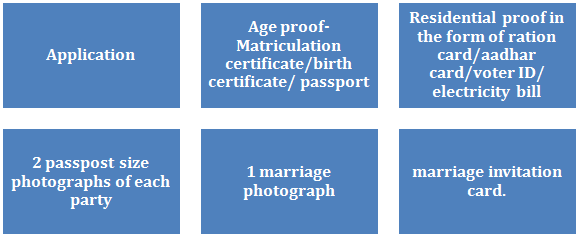
Document required for Marriage registration
Tatkal Marriage Registration
In 2014 the Revenue Department of Delhi introduced tatkal marriage registration service. It ensures that the marriage certificate is generated within single day. It enables the people to get the certificate within 24 hours at a nominal fee of Rs. 10,000/-.
Marriage between an Indian and a Foreigner
If an Indian is marrying with a foreigner in India, the Special Marriage Act, 1954 will be applicable where both an Indian and a Foreigner intent to marry in India. In the same way, when an Indian intends to marry in any other country, the Foreign Marriage Act, 1969 will be applicable.
Therefore, it can be implied that a marriage solemnized between an Indian and a Foreigner is civil in nature. Moreover in these cases, No Impediment Certificate/NOC from the concerned Embassy and valid VISA is mandatory.ll other documents are the same as any other marriages performed under the Special Marriage Act, 1954.
Is registration mandatory if married in Arya Samaj Mandir?
Many parties who are Hindus opt for Arya Samaj marriage. These marriages take place in an arya samaj mandir. These marriages follow Hindu customs and rituals after the documents are verified.
Even if one gets married in Arya Samaj Mandir, they still have to get the marriage registration by the Registrar. As a result the parties have to complete the documentation. After which the Registrar will examine the documents and witnesses before issuing certificate.
Conclusion
By and large India is a country of diverse religions; each of them have their own set of marriage ceremonies. Usually after marriage we often overlook registering our marriage. This may lead to a lot of problems for the bride and groom. Hence, we should register our marriage as soon as possible. It is the easiest and most uncomplicated legal procedure in India.
Post a query here at LawyerINC and our team of expert lawyers will help you get your marriage registration certificate in no time.